
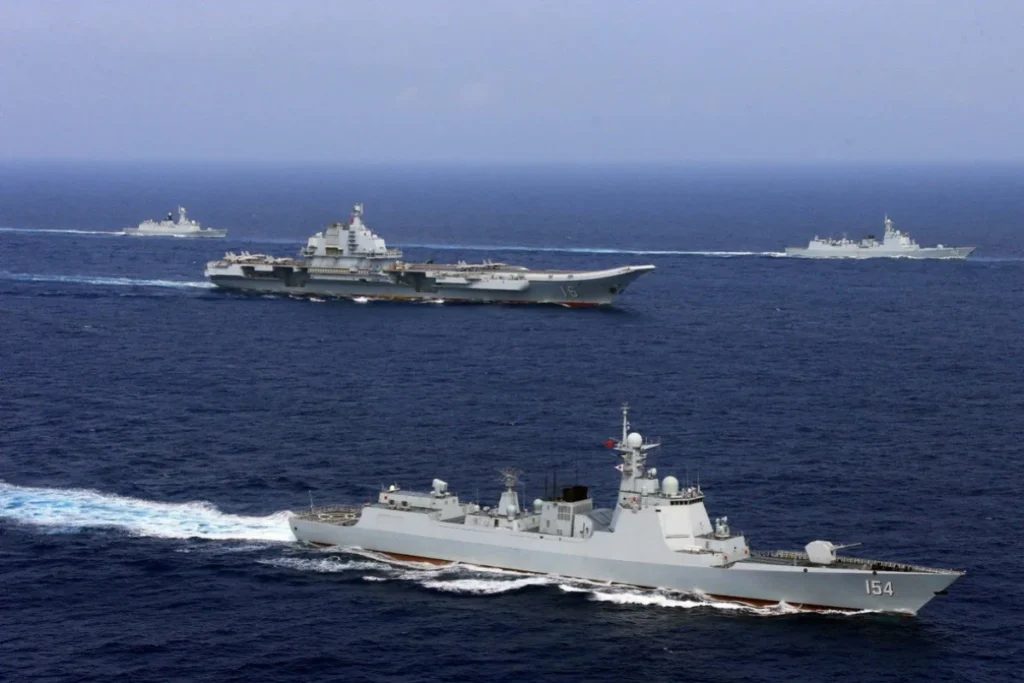
This marks the inaugural defence collaboration within the BRICS framework, with reports indicating the participation of the Russian and Iranian navies.
China will coordinate a joint naval exercise with Brics nations in South African waters next week — the bloc’s inaugural such defence collaboration, which is likely to provoke concern in Washington.
The South African National Defence Force announced on Wednesday that the exercise—named Will for Peace 2026—would assemble navies from Brics Plus countries for an intensive schedule of joint maritime safety operations, interoperability drills, and maritime protection exercises from January 9 to 16.
Also read: BRICS Research Grant For Indonesia 2026 – Call for Applications
It stated that China would take the lead in the exercise but did not specify which other nations would participate. Media reports have identified Russia and Iran as participants, with Indonesia and Ethiopia also expected to participate.
According to South Africa’s defence ministry, the joint exercise “demonstrates the unified commitment of all participating navies to protect maritime trade routes, improve collaborative operational procedures, and strengthen cooperation in support of peaceful maritime security initiatives.”
The joint exercises were formerly referred to as Exercise Mosi and were conducted by China, South Africa, and Russia in 2019 and 2023.
Also read: 2025 Disability Grants in South Africa – Funding from R50k – R1.7m
The most recent exercise was initially scheduled for November 2025 but was deferred to prevent conflicting with the Group of 20 summit in Johannesburg.
Brics – initially consisting of the emergent economies of Brazil, China, Russia, India, and South Africa – expanded in 2023 to encompass Iran, Egypt, Ethiopia, Indonesia, and the United Arab Emirates.
The bloc has primarily concentrated on economic collaboration, and although it has begun to assume a more significant role in geopolitical matters, there has not yet been any defence cooperation within the Brics framework.
As the competition between the United States and China has grown more intense in recent years, Beijing has promoted Brics as a vital platform for the Global South to contest U.S. predominance in the global order. US President Donald Trump has pledged to implement trade sanctions should the group undertake actions to dethrone the dollar.
Also read; How To Get Funding For Business In India (Top International Grants)
China has deployed its Type 052DL guided-missile destroyer, the Tangshan, along with its Taihu supply ship, to participate in the upcoming week’s exercises, according to an African news portal, DefenceWeb, reported on Tuesday.
The two vessels, which are components of China’s naval escort task force in the Gulf of Aden, visited Mombasa, Kenya, last Wednesday for maintenance prior to proceeding south.
Iran and Russia have also dispatched warships to South Africa this week, according to media reports.
Paul Nantulya, an authority on the Chinese military at the US National Defence University’s Africa Centre for Strategic Studies, stated that the exercise continued a pattern of redeploying units already engaged in counter-piracy operations for regional manoeuvres and port visits.
Also read: Call for Proposals: NPO Funding for 2026/2027 (South Africa)
However, he indicated that Iran’s involvement—whose tensions with the United States intensified following U.S. air strikes on three Iranian nuclear facilities in June—and the rebranding of the manoeuvres as a BRICS event may represent a departure from the previous two exercises.
“Although this particular drill adheres to a standard pattern for the [People’s Liberation Army], it is indicative of a larger trend of expanding Chinese military activities that is expected to persist throughout 2026,” Nantulya further stated.
He stated that the PLA “is increasingly perceiving itself as a global power” and that collaborating with diverse international forces “enhances its operational capabilities and facilitates a degree of interoperability with chosen partners.”
Mihaela Papa, Director of Research and Principal Research Scientist at the MIT Centre for International Studies in the United States, observed that China refrained from establishing formal military alliances.
“[China] instead depends on adaptable security collaborations with prominent non-Western partners, utilising joint exercises to demonstrate presence and enhance operational coordination,” she stated.
Also read: Call for Applications: Russia Small Business Grants 2026
Analysts further indicated that increasing the scope of the joint exercise might weaken Pretoria’s assertion of neutrality and exacerbate tensions in its relations with Western nations.
South Africa’s Democratic Alliance, a member of the coalition government, stated that engaging with sanctioned states could jeopardise relationships with key Western trading partners.
DA defence spokesman Chris Hattingh informed local media that hosting Iran and Russia has rendered it increasingly challenging for the government to assert that South Africa is sincerely committed to a policy of non-alignment.
Francois Vrey, Professor Emeritus of Military Science at Stellenbosch University in South Africa, stated that engaging in joint exercises with sanctioned nations could potentially deteriorate diplomatic relations with the United States.
That relationship has deteriorated since Trump’s reappointment to the White House, particularly concerning Pretoria’s land reform policy, a suspension of US aid, and trade issues.
According to Papa, although fraught relations with Washington had strengthened Pretoria’s pursuit of strategic autonomy, South Africa’s influence remained constrained as the United States reduced its emphasis on African security.
Also read: Call for Applications – Funding for Small Business in India
Source: myNews